
7 hidden causes of chronic back pain
Have you ever noticed how back pain has a habit of returning just when you thought you’d cracked it?
You do the physio. You rest. You try the injections, the stretches, the YouTube videos at midnight. Things ease off. You start to feel hopeful.
And then it comes back.
If that’s your experience, I want to ask you something. What if the pain returning isn’t your body failing you, but your body trying to tell you something that hasn’t been heard yet?
Because in my experience, back pain that keeps coming back almost always has a reason. And that reason is rarely where you’d expect to find it.
The bit that surprises most people
Here’s something I find myself saying again and again.
The place that hurts is rarely the place where the problem started.
Your lower back bears the load. But what’s forcing that load onto your lower back might have started at your hip, your ankle, or even an old knee injury from years ago that quietly changed the way your whole body moves.
Sciatica is the same. The pain travelling down your leg is real, but what produced it often traces back to movement habits that have nothing to do with your spine.
This is why treating the painful area alone so often only works for a while. You’re addressing what you can feel, not what’s actually driving it.
7 reasons your back pain may not have resolved
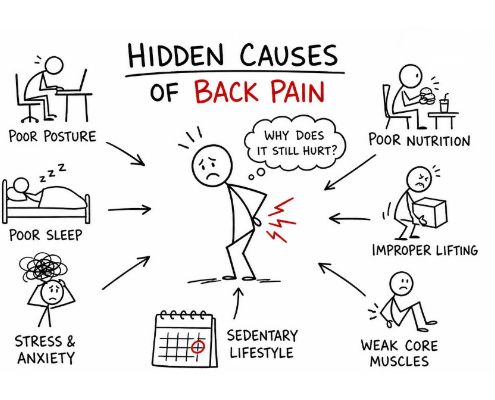
None of these are rare or complicated. Most are patterns – movement habits, lifestyle factors, old injuries – that fall through the cracks of standard care because they require someone to look at how the whole body works together, not just scan the area that’s hurting.
1. The original strain never fully healed
Muscle strain is the most common cause of lower back pain. And often, it does heal. But sometimes people return to the same movements, the same habits, the same way of carrying themselves – before the body has really had a chance to reset. The surface heals, but the underlying pattern doesn’t. And so the same structures keep getting stressed, in the same way, again and again.
2. Disc degeneration combined with poor movement
Not everyone with degenerative discs has pain. Two people, same scan, completely different experiences.
So what makes the difference? Usually, it’s how the rest of the body is loading that disc. When movement patterns are off, a disc that would otherwise sit quietly starts to become a problem. The disc isn’t really the issue – it’s what’s happening around it.
3. The scan that only tells half the story
Scans are useful. But they have limitations that don’t always get explained.
Facet joint arthritis, spinal stenosis – these are real findings. But a scan shows structure, not movement. It can tell you what something looks like, but not why it’s behaving the way it is, or what’s been loading it.
Treating what the scan shows, without asking what’s been driving the problem, often brings relief for a while. And then the pain creeps back.
4. A herniated disc that keeps returning
This one frustrates so many people – and understandably so.
The disc heals. The pain eases. And then months later, it’s back.
What almost always gets missed is the movement pattern that caused the herniation in the first place. If that hasn’t changed, the disc is going to keep being put under the same pressure. The body hasn’t been given a reason to respond differently.
5. An old injury you’d almost forgotten about
An old ankle sprain. A knee problem years ago. A hip issue that seemed to sort itself out.
Old injuries change how the body distributes load through the spine – often for years, sometimes for decades. Assessments that don’t look below the waist routinely miss this. And that blind spot keeps people stuck.
6. The way you sit, day after day
Most of us spend a lot of time sitting. And the body wasn’t really designed for that. Over time, prolonged sitting gradually switches off the muscles that quietly support your spine. By the time pain shows up, the pattern producing it has often been building for months – sometimes longer. It’s a bit like mopping the floor while the tap is still running. Until the pattern changes, the pain will keep coming back.
7. Stress, anxiety and a nervous system on high alert
This one matters more than most people realise – and it rarely gets the attention it deserves. When we’re stressed or anxious, the body holds tension differently. And when that stress becomes chronic, the nervous system can become so sensitised that even normal sensations start to register as pain. This isn’t pain being “all in your head.” It’s your body responding to everything it’s carrying – not just physically, but emotionally too. And when that piece gets ignored, recovery often stalls – even when everything else looks right.
When to seek urgent help
Most back pain is mechanical – and manageable. But occasionally, symptoms can point to something that needs immediate medical attention, and it’s important to know the difference.
Please don’t wait it out if you notice any of these alongside your back pain: new loss of bladder or bowel control, numbness in your inner thighs or groin, progressive leg weakness, or fever alongside unexplained weight loss and night pain that doesn’t ease when you change position.
These are uncommon. But they matter. Please seek emergency care rather than trying to manage them independently.

The single question that changes everything
Most practitioners ask: “Where does it hurt?”
I ask: “Why has your body adapted in this way? What has it been trying to protect?”
Because your body isn’t broken. It’s been doing its best with what it has – compensating, adapting, finding ways to keep you moving even when something wasn’t right.
The pain isn’t your enemy. It’s asking you to pay attention.
And when you finally do, that’s when everything starts to change.
Ready to find out what your body’s been trying to tell you?
If you’re fed up with temporary fixes and being told to just manage your pain, I can help.
Together we’ll uncover what’s really been driving it – without the overwhelm, the guesswork or yet another approach that only helps for a while.
Because real relief isn’t about silencing pain. It’s about understanding what’s behind it.
